
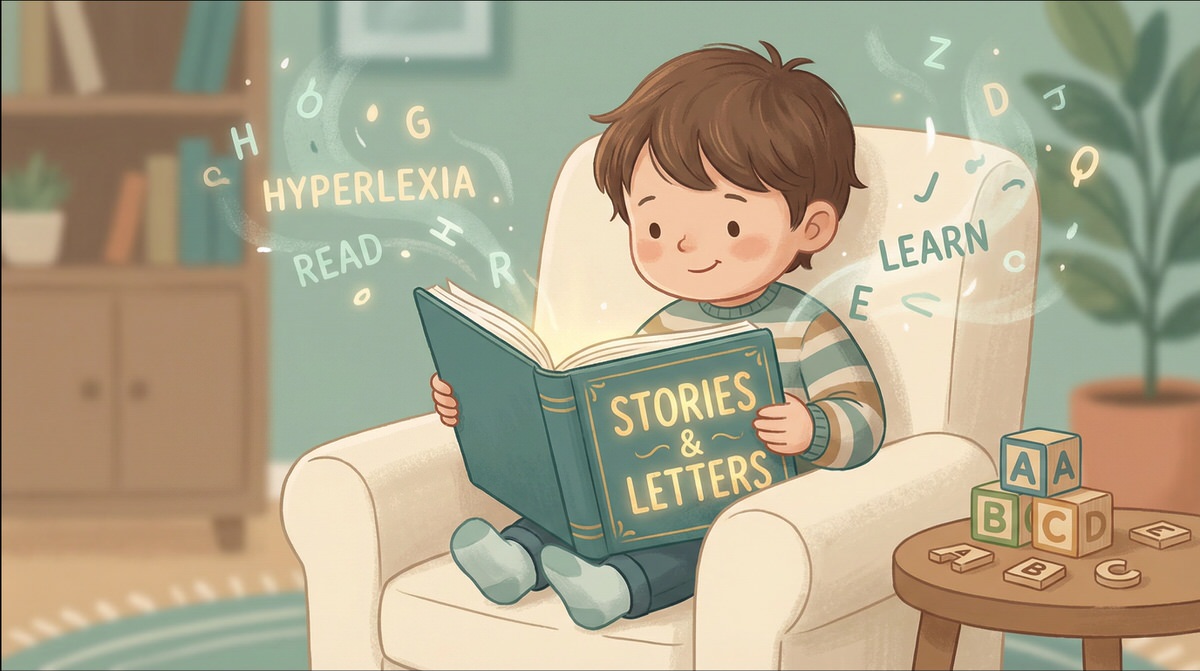
Have you ever met a toddler who could read words long before they could speak in full sentences? Or a young child who can decode complex text with stunning accuracy, yet struggles to explain what they just read? This fascinating and often misunderstood profile is known as hyperlexia.
On the surface, it can look like giftedness. A child with hyperlexia might recognize letters and numbers as a toddler, read signs on the street, and even memorize entire books. But hyperlexia is a unique developmental path where the ability to decode words far outpaces the ability to comprehend their meaning.
The Gap Between Reading and Understanding
The hallmark of hyperlexia is the significant gap between a child’s advanced reading skills and their language comprehension. While they can read a page flawlessly, they may struggle to:
- Follow the plot of a story
- Answer questions about what they’ve read
- Understand the characters’ motivations or feelings
- Grasp the main idea of a text
This isn’t a lack of intelligence; it’s a different way of processing language. The skill of decoding is real and impressive, but the gap in understanding is just as real and requires gentle, targeted support.
A Connection to Neurodiversity
Hyperlexia is frequently, though not always, seen alongside other neurodevelopmental profiles, most commonly autism. For many of these children, the world can feel unpredictable and overwhelming. Social cues are confusing, and sensory experiences can be intense.
In this context, letters and numbers become a source of comfort and stability. They are predictable, logical, and follow clear rules. Reading becomes a way for the child to find structure and regulate their emotions in a world that often feels chaotic.
How Hyperlexia Shows Up
Beyond early reading, hyperlexia can manifest in several ways. A child might:
- Memorize and repeat entire books, scripts from TV shows, or echo phrases with perfect precision.
- Be intensely drawn to letters, numbers, and written words.
- Prefer organizing letter tiles, copying text, or spelling words repeatedly over conversation.
These behaviors are not meaningless “obsessions.” They are a form of communication and a way for the child to process their world, organize their thoughts, and self-soothe.
The Brain Behind the Pattern
Hyperlexic learners often process language by focusing on the details first and constructing the meaning second. Their brains are wired to spot patterns and details instantly, which is why they excel at decoding.
However, understanding context, relationships, emotions, and the hidden meaning between the lines takes more time and requires explicit support. This uneven cognitive profile explains how a child can possess an impressive, near-photographic memory for words while simultaneously facing challenges with social communication and abstract thinking.
How to Support a Child with Hyperlexia
Support for hyperlexia is most effective when it honors the child’s strengths while gently building the bridge to comprehension. The goal is not to stop their love of reading but to help them connect words with meaning. Effective strategies include:
- Gentle Scaffolding: Build on their existing reading skills to slowly introduce comprehension questions.
- Visuals and Concrete Explanations: Use pictures, diagrams, and real-world objects to connect words to their meanings.
- Structured Routines: Predictable routines help reduce anxiety and create a safe space for learning.
- Explicit Teaching of Meaning: Directly teach vocabulary, figurative language, and social cues within the context of what they are reading.
By understanding the unique profile of hyperlexia, we can provide the right support to help these remarkable readers not only decode the world but truly understand it.
If you recognize these signs in your child and have questions, we’re here to help. Contact CARES for a consultation to discuss how we can support your family’s journey.